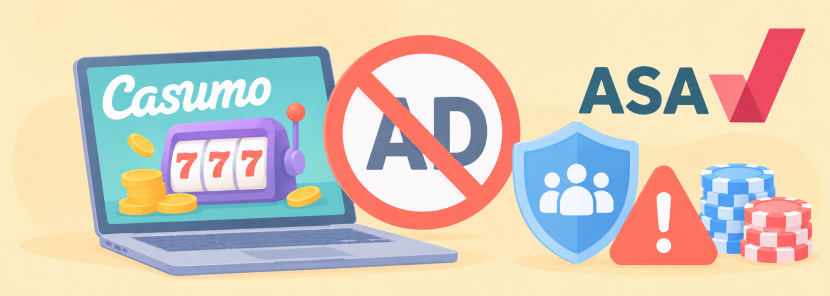

The UK Advertising Standards Authority (ASA) had decided to ban an advertisement for online gambling operator Casumo. It was found that an ad from the operator’s promotions encouraged frequent and repetitive gambling.
The paid-for online display ad, promoting Casumo’s ‘Spinumo’ campaign, was identified through the regulator’s Active Ad Monitoring System, which relies on artificial intelligence to proactively detect potentially non-compliant online advertisements.
The ruling is another early example of the system’s impact on gambling advertising enforcement, after it was put into operation in June 2026. ASA concluded that the ad encouraged socially irresponsible gambling behaviour that could lead to financial harm, breaching CAP Code Edition 12 rules 16.3 and 16.3.1.
AI Monitoring System Flags Casumo Advertisement
Introduced this June, the AAMS was developed to improve the Authority’s ability to spot violations of online advertising rules. The system uses AI to proactively search for potentially problematic advertisements, including those that could target younger audiences.
The Casumo advertisement was identified in August 2026, just months after the system’s official exploitation.
The promotional piece advertised the operator’s “Spinumo” offer, which ran from July 6, 2026 to August 2, 2026. Customers completing a daily mission had to deposit £50 and wager £200 on eligible games to receive one Spinumo Wheel spin.
Each wheel spin came with a randomised number of free spins, for a maximum of 100. Every free spin was worth £0.10, and rewards expired after 48 hours.
The promo allowed users to complete up to five missions a day, which could potentially bring them five wheel spins. Therefore, the maximum participation throughout the 28-day promotional period could involve £7,000 in deposits and £28,000 in wagering.
The advertisement featured the headline ‘UP TO 100 SPINS ON SPINUMO’ as well as a sign-up button and the slogan ‘QUEST. SPIN. WIN.’ ASA considered that the daily mission mechanic presented gambling as a repeatable challenge, directly incentivising customers to increase their participation.
“The description of the qualifying activity as a ‘daily mission’ alongside the wording ‘QUEST. SPIN. WIN.’, presented gambling as a challenge that could be completed repeatedly,” the regulator stated.
“In the context of a promotion offering up to five wheel spins per day, we considered that encouraged consumers to maximise their participation.”
The ASA also questioned the amount of gambling required relative to the potential reward.
It acknowledged that customers could choose whether to complete additional missions and that wagering did not necessarily translate into losses. However, it considered that the promotion encouraged substantial gambling activity at a regular and fixed frequency.
The regulator added that the mechanic risked encouraging continued gambling, particularly among more vulnerable consumers.
Consequently, the ASA ruled that the advertisement must not appear again in its existing form. This is the first instance in which the AAMS has flagged a gambling advertisement and subsequently led to an ASA judgement.
Casumo Defends Its Promotional Mechanics
Casumo defended the promotion during the ASA investigation, arguing that it was a targeted, opt-in offer available to eligible UK customers.
The operator maintained that customers were not required to complete multiple missions or participate every day. They could decide after each mission whether to continue, while the deposit and wagering requirements were clearly outlined in the advertisement’s terms and conditions.
Casumo also argued that the slogan “QUEST. SPIN. WIN.” described the promotional journey rather than suggesting gambling was a route to financial gain. However, the ASA rejected these arguments, finding that each additional mission required another £50 deposit and £200 in wagering in exchange for another opportunity to receive promotional rewards.
The regulator also considered that the possibility of obtaining up to 100 free spins from each wheel spin provided an additional incentive to repeat the qualifying activity. Following the ruling, Casumo stated that it takes great pride in its record of customer protection and regulatory compliance.
The gambling operator added that it carefully considers all regulatory interventions and continually reviews its processes to ensure they reflect best practices across compliance, including advertising under ASA codes and guidelines.
Ruling Sends Warning to Gambling Advertisers
In conclusion, the ASA ordered Recro Ltd, trading as Casumo, to ensure that future gambling promotions do not encourage socially irresponsible behaviour or activities that could lead to financial harm.
While the ruling concerns a single advertisement, it highlights the increasing role of automated monitoring in UK gambling advertising enforcement.
With the AAMS now helping identify potentially non-compliant promos, operators could face greater scrutiny over how their marketing campaigns encourage customer participation. The decision also reinforces the Authority’s stance that optional promotions can still breach advertising rules when their mechanics incentivise frequent or repetitive gambling.
For UK gambling marketing teams, the latest Casumo ruling serves as yet another reminder that promotional structures and advertising messages must be thoroughly reviewed against responsible gambling requirements, not simply the clarity of their terms and conditions.