
According to the latest research published by the UK Gambling Commission, more than a quarter of young people between the ages of 11 and 17 have spent money on gambling activities in the past 12 months.
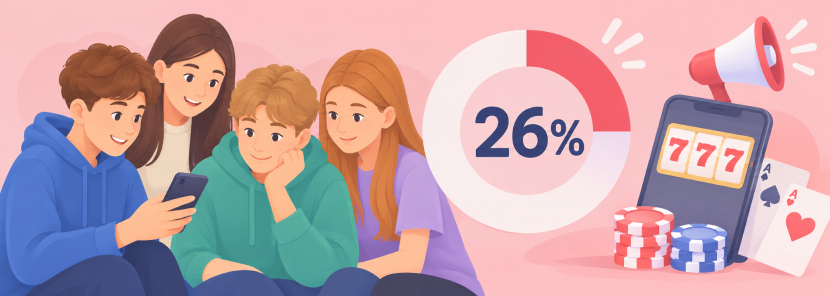
The regulator’s 2026 Young People and Gambling Survey discovered that 26% of respondents had participated in at least one gambling activity using their own money during the 12 months before completing the survey.
Overall participation may have declined since 2022, but exposure to gambling advertising remains widespread. It was reported that almost nine in 10 young people recalled seeing or hearing gambling promotions over the past year.
Ipsos conducted the survey on behalf of the Gambling Commission and collected responses from 3,867 pupils aged 11 to 17 across England, Scotland and Wales. It took place over a span of a few months, between January 12, 2026 and June 12, 2026.
The findings come against the backdrop of a substantial and increasingly accessible UK gambling market. The industry generated £17.5 billion in Gross Gambling Yield during the 2025/26 financial year, with remote casino, betting and bingo accounting for £8.3 billion.
Online gambling allows adults to access betting products and casino games through websites and mobile casino apps, whether at home or on the move. The easy access also means young people can encounter gambling-related content across social media, streaming services and gaming platforms.
Arcade Machines Most Popular Among Young Gamblers
The findings suggest that young people were considerably more likely to spend money on non-age-restricted gambling activities than age-restricted products.
Overall, 24% had participated in non-age-restricted activities, compared with around 5% who had spent money on age-restricted gambling. Arcade gaming machines, including penny pushers and claw grab machines, were the most common activity, reported by 19% of respondents.
Meanwhile, approximately 11% had placed money bets between friends or family members, while 5% had played cards for money with people they knew.
Despite these figures, participation has declined over the longer term. The proportion of young people who spent their own money on gambling fell from 31% in 2022 to 26% in 2026.
Problem Gambling Rates Remain Relatively Stable
Additionally, the UKGC highlighted the potential effect of gambling on young individuals by utilising the youth-adapted DSM-IV-MR-J screening tool.
Based on the results, around 0.9% of respondents scored four or more on the scale, which indicates problem gambling. Then, a further 2% scored two or three, placing them in the at-risk category.
The remaining 23.1% of young people who had participated in gambling activities scored zero or one, indicating no gambling-related problems under the screening measure. The proportion of young people scoring four or more has remained relatively stable since 2022.
Gambling Advertising Reaches Almost 90% of Young People
In addition, exposure to gambling advertising remains a significant feature of young people’s experiences. Around 89% admitted to seeing or hearing gambling promotions in the previous 12 months.
Social media was the most frequently reported channel, with 55% saying they encountered gambling advertisements at least weekly. Other common platforms included live streaming and video-sharing services (53%), television (52%) and mobile apps (51%).
The survey also highlighted differences between boys and girls. Boys were more likely to report seeing gambling advertisements on live streaming and video-sharing platforms, at 57% compared with 39% of girls.
The same pattern was seen with sporting events, where 61% of boys reported exposure, compared with 42% of girls.
Meanwhile, 15% of respondents said they followed gambling-related content on social media or streaming platforms. Among this group, 38% reported that influencers, content creators or streamers they followed had advertised gambling-related products.
The research also examined gambling exposure within households. Around 35% of young people had seen a family member they lived with gamble, rising to 46% among those who had participated in gambling themselves.
Young People Believe They Understand Gambling Risks
Despite widespread exposure, most respondents felt they understood the potential dangers associated with gambling.
Around 81% said they were well informed about gambling-related risks, while 68% reported that someone had spoken to them about the problems gambling could cause. However, the survey also examined young people’s attitudes towards risk-taking.
Overall, 29% described themselves as risk-takers, with boys and older teenagers more likely to identify with this characteristic. Among those who had spent their own money on gambling, the proportion rose to 38%, significantly higher than the overall average.
Loot Boxes Remain Part of the Gaming Experience
The UK Gambling Commission also continued to examine the relationship between gaming and gambling among young people.
Awareness of in-game purchasing features was widespread, with 82% recognising at least one type of in-game item activity. Among those familiar with these features, 84% had used at least one.
The findings also highlighted the popularity of the controversial loot boxes and surprise boxes. Around 22% of all respondents aged 11 to 17 said they had opened these items using their own money.
The 2026 publication forms part of the regulator’s annual monitoring of young people’s gambling experiences, exposure and attitudes. Its findings provide an overview of participation and potential gambling-related harm, alongside the influence of advertising, social media and gaming environments.
The regulator also compared the latest results with previous surveys to identify longer-term trends. Still, some differences in the 2022 sample mean that comparisons should be treated as indicative.