







































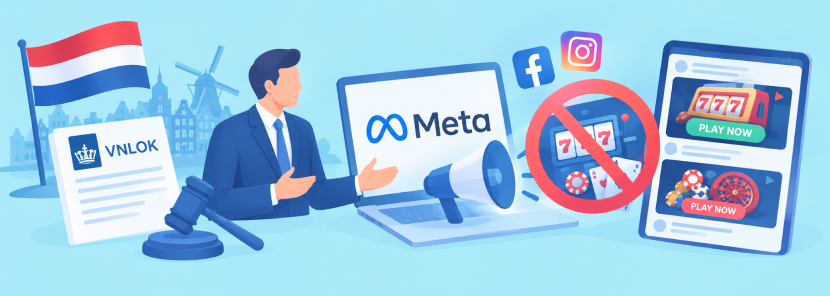

VNLOK Chairman Björn Fuchs is again addressing the topic of Meta advertising illegal gambling and urged the company to take greater responsibility. He argues that the social media giant is exposing Dutch consumers to unregulated operators while legitimate businesses face strict regulatory provisions.
The Dutch gambling trade decided to take Meta to court, marking the first time a gambling industry association has pursued legal action against a major technology company over the issue.
Speaking at the SBC Summit in Lisbon, Fuchs criticised Meta’s response to illegal gambling promotions on its platforms, describing the situation as a digital Wild West.
“It's disappointing seeing the lack of proactivity at Meta. While licensed operators are compliant and thus limited by law, Meta is facilitating a digital Wild West, in which illegal online gambling websites seduce vulnerable Dutch audiences, without any duty of care.”
Fuchs warned that the implications can extend beyond the regulated casino sector, with Dutch consumers and society absorbing the cost of inefficient enforcement.
Illegal Advertising Adds to Existing Challenges
It’s no secret that the Netherlands is experiencing channelisation struggles, which is the measure for the proportion of gambling activity taking place with Dutch licensed casinos.
Numbers suggest that the channelisation rate fell to 49% in 2025, which was down from 57% in 2024 and 66% in 2023. The figures highlight growing concerns about the competitiveness of the regulated market after its launch in 2021.
The combination of strict marketing rules, a hefty gross gaming revenue tax rate of 37.8% and extensive player protection obligations has contributed to concerns about consumers turning to unlicensed alternatives.
A while back, Fuchs cautioned that excessive regulation could undermine the regulated market’s position. However, he also noted that illegal gambling advertising on Meta’s platforms is a significant factor in the Netherlands’ growing illegal market problem.
According to the VNLOK chairman, licensed operators are subject to restrictions that do not apply equally to their unlicensed competitors, which can promote more appealing bonuses and other incentives to Dutch audiences.
In his words, a company like Meta is expected to do much better when it comes to dealing with or filtering illegal gambling promotions.
He also questioned whether consumers can tell the difference between licensed and unregulated gambling websites, despite efforts by the Dutch Gambling Authority (KSA) to raise awareness about it.
“It's positive to see that the KSA is ramping up more campaigns for their information platform. The most important question is: does the public even care?” he added.
Fuchs cited research conducted by KVA, the Responsible Affiliates Quality Mark, which analysed searches for illegal gambling websites and terms such as ‘casinos without limits’ and ‘no verification casinos’.
According to the research, monthly searches for such terms exceed the one million mark in the Netherlands, which suggests that users are actively seeking gambling options outside the regulated market.
Calls for Stronger Platform Enforcement
VNLOK’s legal action comes after numerous calls from gambling industry organisations for social media companies to do more to prevent illegal operators from reaching consumers.
In June, the UK’s Betting and Gaming Council issued an open letter urging technology platforms to remove illegal gambling advertisements. The European Gaming and Betting Association also called for stronger enforcement under the EU’s Digital Services Act.
However, despite these efforts, illegal gambling promotions continue to appear across major social media platforms, prompting questions about the effectiveness of existing protections.
Fuchs believes the process of determining which gambling businesses can advertise in a particular market should be relatively straightforward.
“Every licence has a certain jurisdiction. If that's not the case, then every jurisdiction has a list of licensed operators. If you're not on the Dutch list, you shouldn't be able to target Dutch audiences. It really isn't rocket science.”
His comments reflect the regulated industry’s broader argument that platforms should verify operators’ licensing status before allowing them to advertise gambling products to consumers in specific jurisdictions.
Meta Partnerships Could be the Way Forward
Despite the dispute, there have been some developments that suggest that cooperation between Meta and parts of the gambling industry remains possible.
For instance, Nordic operator Paf recently announced a pilot project with Meta to support efforts against illegal gambling. Via the initiative, the two will share information, including licence documents and website URLs, which should help the technology company identify unregulated platforms.
Another example is that Thailand's Ministry of Digital Economy has committed to working with social media platforms, including Meta and TikTok, to tackle illegal gambling.
Fuchs acknowledged that cooperation could help address the problem, but he insisted that platforms should already be capable of preventing unlicensed operators from targeting restricted markets.
VNLOK is also in contact with other European gambling trade bodies as the dispute develops.
“There have already been various court cases against Meta in different European countries. At this point, we're actively exchanging information and insights. Future collaboration is possible. The same goes for our contacts with various European government agencies.”
His comments indicate that VNLOK is open to starting wider cooperation with industry organisations and government agencies as it seeks stronger action against illegal gambling advertising.
However, with channelisation continuing to drop and unlicensed operators retaining access to digital advertising channels, the dispute highlights a broader challenge for regulated gambling markets. Regulators must ensure that online platforms apply sufficient safeguards while licensed businesses operate under increasingly stringent rules.