











































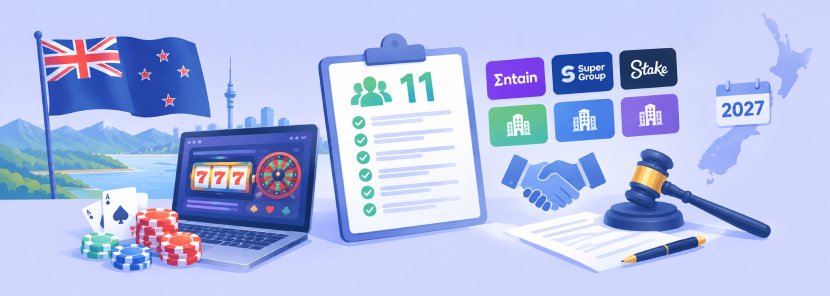

New Zealand’s online casino licensing auction has come to an end, with 11 companies securing the right to apply for licences in the country’s new online gambling framework. The auction drew 32 bids and ended after 10 rounds, with the final price reaching NZ$15 million per permit.
The Department of Internal Affairs published the results this week, confirming the applications that can advance to the next stage of the licensing process. Major gambling operators Entain, Super Group and Stake are among those looking to enter the regulated market.
New Zealand is on track to launch its regulated online casino market in 2027. The new system will include up to 15 licences, with each licence covering a single brand and the platforms used to access its services.
Licences will be valid for three years, with the option of an extra five-year extension. However, each operator can secure a maximum of three licences, allowing companies with multiple brands to pursue different opportunities in the market.
Entain, Super Group and Stake Among Successful Bidders
Super Group, the owner of Betway, secured three rights to apply through its Baytree Interactive Limited. Entain also secured multiple rights, earning two through Playvia Gaming (NZ) Limited and another through TAB New Zealand.
According to industry reports, currently, TAB NZ operates under a 25-year strategic sports betting partnership with Entain. The arrangement could provide the company with an advantage in developing its online gambling offering alongside its existing sports betting presence.
Meanwhile, Entain has already introduced the BlackRush Casino and FoxySpins brands in New Zealand. The company has previously spoken about the market opportunity, particularly its ability to combine casino and sports betting offerings through its relationship with TAB NZ.
An Entain spokesperson said the company was pleased to have reached the final licence stage for its BlackRush and Foxy brands, alongside TAB NZ. They also acknowledged that a comprehensive application and due diligence process remained before any licences could be granted.
Additionally, Stake New Zealand Limited also secured the right to apply for a licence. The international company described the opportunity as part of its wider expansion strategy, after it entered into other key gambling jurisdictions throughout 2026.
The other bidders are Christchurch Online NZ Limited, One Casino Limited, Rush Entertainment Limited, Skill On Net Limited, Rock Swift Group Limited, SkyCity NZ Online NO1 Limited and SkyCity NZ Online NO2 Limited.
One Casino Limited is associated with LCKY, formerly known as Glitnor Group, while Skill On Net Limited represents the Malta-based SkillOnNet business. Meanwhile, SkyCity booked two slots to apply through its separate online entities, potentially allowing the land-based casino operator to bolster its footprint across different channels.
Rock Swift Group Limited and Christchurch Online NZ Limited also secured places in the next stage. The latter should not automatically be assumed to be connected to Christchurch Casino, as industry reporting identifies it as a separate Malta-registered business.
Concerns Around NZ$15 Million Licence Fee
The auction concluded with a final price of NZ$15 million per licence. However, industry representatives debated whether the fee was expensive, and noted that it exceeds the reported cost of obtaining a licence in Brazil’s regulated market, where the fee was €5.2 million.
The auction utilised an ascending clock format, in which participants were offered progressively higher prices and could either remain in the process or withdraw. The process continued until demand matched the number of available licences.
DIA went for such an approach to promote transparency and fairness, with all participants facing the same prices at each stage. However, the auction only determined which entities could proceed to the application stage. The successful bidders must still demonstrate that they are suitable to operate under New Zealand’s regulatory requirements.
Licence Applications and Compliance Requirements
Now, successful bidders must submit their applications, pay the relevant auction-determined amounts and provide information demonstrating their suitability to operate in New Zealand.
Applications will include business plans and detailed strategies covering advertising and marketing, consumer protection, harm prevention and minimisation, and regulatory compliance. The DIA will also consider information submitted during the earlier expression-of-interest stage.
The Online Casino Gambling Act 2026 has already established the legal framework for the new market, including supporting rules that cover consumer protection, record-keeping, harm minimisation, advertising, marketing, fees and levies.
The licensing process is intended to establish a regulated environment with formal obligations for operators. However, the authority must assess each application before granting permission to operate, meaning the 11 successful auction participants have not yet secured their final licences.
Unlicensed Operators Face December Deadline
However, New Zealand banned online casino gambling advertising since the new legislation commenced in May this year. Operators must not advertise their online casino gambling services to customers in the country during the transition to the regulated market.
A key deadline is December 1, 2026, which states that casino providers that have not submitted a licence application must suspend operations in New Zealand.
Operators that submit applications may continue operating while their cases are assessed, but they must remain subject to the applicable restrictions and cannot advertise their services. Businesses whose applications are rejected will be required to exit the market.
The DIA has also warned providers to maintain compliance with existing legal requirements during the transition, noting that their compliance history may be considered during the licensing process.
With major international operators among the successful bidders, New Zealand’s next licensing stage will determine which businesses can establish a long-term presence in the regulated online casino sector. The full market is expected to launch in 2027, but the DIA has not specified an exact date.