







































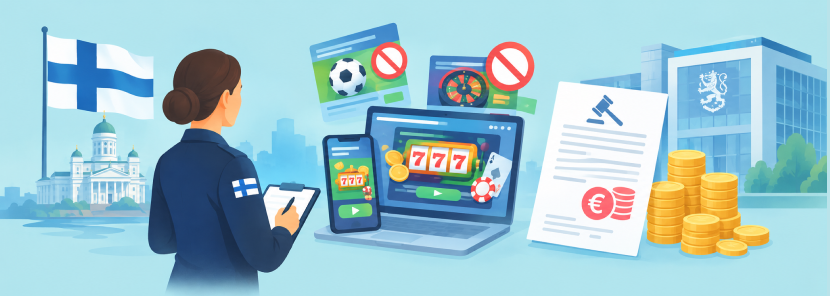

In Finland, the National Police Board is ramping up its efforts in enforcement against illegal gambling marketing. This week, the department announced that it has issued four prohibition orders and six conditional fines to international companies.
The measures target unregulated gambling promotions on websites and social media, with penalties reaching €1.2 million for companies. The NPB’s Gambling Administration oversees gambling marketing and intervenes when companies or individuals violate the Lotteries Act.
Under the current model, only the state-owned Veikkaus Ab is allowed to market gambling products across Finland. Illegal marketing most often consists of advertising, promotional activities and other measures intended to increase demand for gambling.
According to Finnish authorities, social media platforms and gaming communities are the most common channels for unlawful promotions, which can seek to attract Finnish consumers to online casinos.
Conditional Fines Aim to Tackle Illegal Promotions
The National Police Board is authorised to issue prohibition orders to companies and individuals involved in illegal gambling marketing. These orders are generally accompanied by conditional fines intended to ensure compliance and prevent the prohibited activity from occurring again in Finland.
Juhani Wallinvirta, Group Manager at the National Police Board, stated that conditional fines are a necessity to ensure that illegal marketing stops immediately and effectively.
“The purpose of the fine is not to punish the illegal activity, but to reinforce compliance with the prohibition order and ensure that the unlawful marketing actually ceases,” Wallinvirta explained.
The size of the conditional fine is determined by the scale and nature of the violation, as well as the financial capacity of the operator who violated the rules. For example, authorities can demand payment when a party fails to comply with a prohibition order by the specified deadline.
Wallinvirta added that gambling marketing could have effects beyond simply informing consumers about available gaming products. Promotional activities can increase awareness of operators and gambling opportunities, stimulate demand and encourage people to start or continue gambling.
Fines Reach €1.2 Million for Companies
Numbers released from the National Police Board for 2026 suggest the scale of its response to illegal gambling promotions. The authority has issued four prohibition orders and imposed six conditional fines for payment, with cases involving marketing on websites and social media.
Conditional fines attached to prohibition orders range from €30,000 to €200,000 for individuals and from €100,000 to €1.2 million for private companies. The six fines ordered for payment have been directed at individuals and ranged from €20,000 to €100,000.
However, it should be mentioned that a conditional fine is not automatically payable when a prohibition order is issued. Instead, the authority orders payment only when the recipient has failed to comply with the order by the deadline, meaning the illegal marketing has not stopped as required.
The National Police Board insists that the use of conditional fines is necessary when unlawful activity continues despite an earlier warning, and when there are reasonable grounds to believe the responsible party would otherwise disregard a prohibition order.
Finland Targets Gambling-Related Harm
The recent enforcement actions form part of Finland’s broader efforts to tackle and reduce gambling-related harms. Experts warn that the risks can affect not only gamblers themselves but also their families and society.
Previously, authorities have outlined the particular challenges that can be caused by online gambling, especially where games are easily accessible and quick-paced. In addition, digital marketing can reach large audiences within a short period of time, which can potentially increase exposure to gambling and encourage participation.
NPB argues that effective enforcement requires measures capable of ensuring that illegal promotions are quickly stopped. Conditional fines are intended to make prohibition orders effective and support compliance with the Lotteries Act.
Finland’s current rules reserve gambling marketing on mainland Finland for Veikkaus. The latest enforcement figures demonstrate the authorities’ continued efforts to prevent other operators and individuals from promoting gambling unlawfully.
Bracing for Market Opening
In the meantime, Finland is preparing to end Veikkaus’ monopoly over online gambling and betting. The country’s competitive market is scheduled to open on 1 July 2027, with lots of private operators expressing interest in joining the market.
Since March 1, 2026, international companies have been able to submit their applications. According to the latest numbers from the NPB, it has already received 75 applications as of September 22, which is an improvement from the reported 50 in June.
Applications have already exceeded initial expectations, with University of Helsinki researcher Janne Nikkinen previously predicting that they would be between 40 and 60. Still, the 75 submissions do not necessarily represent 75 separate companies, as operators can apply for different gambling activities. Applications are expected to take six to eight months to process.
One of the most notable foreign names that seeks to enter the market is Unibet, which confirmed that it has submitted its licence application. Under the new system, gambling operators will face a tax rate of 22% of gross gaming revenue.
The market opening is expected to increase competition and advertising, raising questions about how regulators will balance the channelling of players towards licensed operators with the need to prevent gambling-related harm.