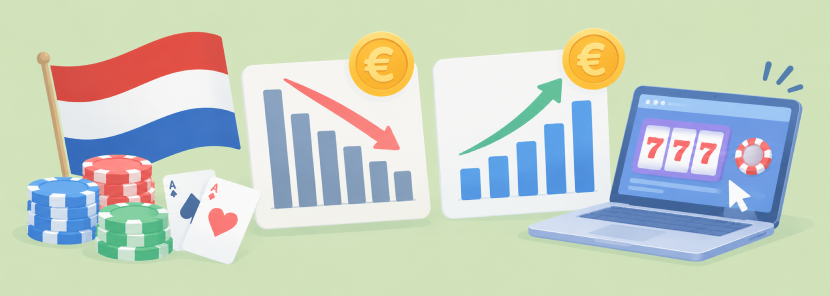

The Dutch Gambling Authority (KSA) has provided an update on the current state of the regulated casino market. According to the regulator, gross gambling revenue fell from €4.5bn to €4.1bn, but online revenue recovered in the first half of 2026, while active player accounts increased.
KSA’s new market report was published on October 29, 2026, and it highlights changes in gambling revenue, consumer behaviour, market channelisation, and potential gambling-related issues.
In 2025, revenue from Dutch online casinos dropped by 18.2%, while online sports betting proceeds decreased by 30.2%. The regulator reckons new player protection measures from late 2024 may have contributed to the decrease. Sports betting revenue was also affected by the comparison with 2024, when the Euro 2024 football tournament boosted activity.
Meanwhile, revenue from physical gaming machines in arcades and hospitality venues fell by 4.7%. Holland Casino reported a 2.8% increase, which was driven mainly by gaming machines, while lottery revenue declined by 1.8%.
Online Revenue Recovered in 2026
The online market showed signs of recovery in the first half of 2026, as gross gambling revenue reached €670m. This was up from €602m in the second half of 2025, or an increase of around 11%.
Unsurprisingly, online casino games generated the largest chunk as they accounted for roughly 73% of online revenues. Sports betting was second with €163m, or 24%. The casino share declined from 78%, while sports betting’s share increased from 20%. The FIFA World Cup, which began in June 2026, may have contributed to the growth in sports wagers.
As of the end of June 2026, there were 31 licensed operators in the Netherlands’ regulated market, with 28 actively offering gambling products.
Active Accounts Spike Despite Stable Player Numbers
Furthermore, KSA reported that the average number of active accounts rose to 1.48 million per month in the first half of 2026, compared to 1.38 million in the previous six months. The number of newly opened accounts also increased, reaching 563,000, up from 529,000.
However, the number of people who gambled with licensed operators at least once during the period remained broadly stable at around 820,000. The average number of monthly players fell slightly, from 510,000 to 490,000.
KSA suggests that the increase in accounts may partly reflect the introduction of stricter deposit limits in October 2024, which could encourage some players to use multiple accounts. The World Cup may also have contributed to the increase in wagering activity.
Despite representing just 9.2% of the adult population, young adults aged between the ages of 18 and 23 accounted for 22% of active gambling accounts. They contributed approximately €68m in gross gambling revenue, or equivalent to 10.1% of the online total.
Channelisation Improves, But at a Cost
The ratio of players playing on licensed gambling platforms remained high, with player channelisation estimated at between 94% and 97%.
Channelisation measured by gross gambling revenue improved from 54% to 59%. The difference between the player and revenue numbers suggests that people gambling on illegal operators may account for a disproportionately large share of total losses. However, data from the illegal market remains less reliable.
The report also found that average monthly losses per online gambler increased by 13%, from €121 in the second half of 2025 to €137 in the first half of 2026. Still, it was below the €160 from the first half of 2024, before stricter duty-of-care requirements were introduced.
Around 54% of active accounts recorded monthly results between a €100 win and a €100 loss. A further 36% lost between €100 and €1,000 per month, while approximately 48,000 accounts, or 0.5% of the total, lost more than €1,000. This last group accounted for 13% of online gross gambling revenue.
Increase in Gambling Addiction Treatment
Worryingly, the number of people getting treatment for gambling-related issues increased by 14% in 2025, putting them at 3,108 compared to 2,708 in 2024.
According to numbers from the National Alcohol and Drugs Information System (LADIS), the number of people receiving treatment for gambling addiction as their primary problem rose by 14% in 2025, reaching 3,108, compared with 2,708 in 2024,
An Ipsos survey from early 2026 found that 65% of online gamblers showed no signs of problematic gambling, unchanged from the previous year. The proportion classified as high risk remained at 9%, while the low-risk share increased from 15% to 18%. The proportion at moderate risk fell from 11% to 9%.
Meanwhile, the number of people registered in the Netherlands’ central self-exclusion system, CRUKS, reached 120,200 by July 31, 2026. Voluntary registrations continued to increase by an average of around 2,000 per month.
Requests and notifications for involuntary registration also rose, as they hit 746 in the first half of 2026, compared with 442 in the previous six months. The KSA attributed the increase to gambling operators submitting more notifications as part of their duty-of-care obligations.
Gambling Advertising on the Decline
The report also highlights a reduction in online gambling advertisements. The number of advertisements fell from approximately 75,000 per month in the second half of 2025 to 50,000 per month in the first half of 2026, a decline of around one-third.
However, posts on Facebook and Instagram increased, particularly in the second quarter, during the FIFA World Cup. Still, advertising activity on X remained very limited, as the platform does not offer the minimum-age setting required under rules governing untargeted gambling advertising.
The number of non-players visiting licensed gambling websites also increased, from around two million in the second half of 2025 to 2.5 million in the first half of 2026.
Overall, the Authority’s findings show a Dutch gambling market that contracted in 2025 before recovering online in early 2026. Channelisation may have improved, and most online gamblers were classified as non-problematic, but rising average losses and an increase in gambling addiction cases underline the continued challenges facing player protection efforts.