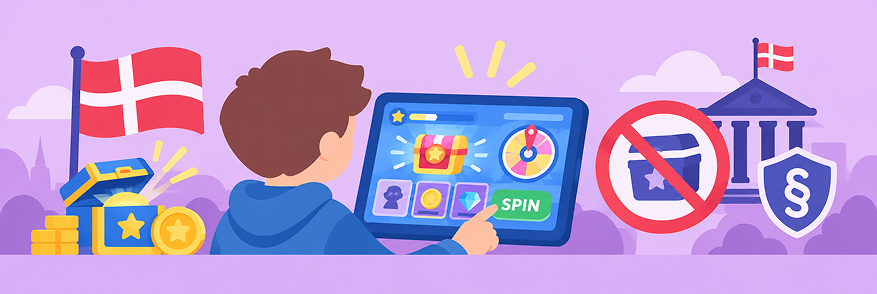

This October, the Danish Gambling Authority (Spillemyndigheden) launched a new campaign to raise parents’ awareness of gambling-related elements in video games children and young people play.
Officially launched on October 26, 2026, the Casino in the Children’s Bedroom campaign advises parents to look beyond screen time and take a closer interest in the content of the games their children play, including features that can resemble gambling.
The campaign discusses how mechanics found in some video games can expose children to gambling-like experiences, even when they are not playing traditional gambling products. Through the initiative, the regulator hopes to encourage conversations within families about gaming and its potential risks.
“Debates about children and digital media often focus on screen time. But it is also important to take an interest in the content of the games and the mechanics children encounter when gaming,” said the Authority’s Director Anders Dorph.
As part of the campaign, the authority is directing parents and professionals to StyrPåSpillet.dk. This is an information platform that offers valuable resources on gaming, gambling-related elements and gambling addiction. The website also provides guidance on how parents can discuss these topics with children and young people.
The campaign comes amid wider scrutiny of gambling-like mechanics in video games. For instance, in Austria, the Supreme Court ruled that loot boxes do not constitute gambling under the country’s Gambling Act, finding that skill outweighs chance and that virtual items have no recognised real-world monetary value.
Storefronts Turned Into ‘Casinos’
Still, the campaign from the Danish regulator features a film that shows how a child’s bedroom transforms into a casino with colourful slot machines, illustrating how gambling-adjacent features can enter children’s gaming activities.
The gambling regulator has also arranged for three storefronts in Denmark to be decorated under the title “Casino Kids”. With installations being located at Bruuns Galleri in Aarhus, Vestergade in Odense and Købmagergade in Copenhagen.
Passers-by will notice a large advertisement announcing the opening of a new casino for children. Naturally, the apparent launch is fictional, with the storefronts instead serving as a way to draw attention to the campaign and encourage parents to examine the games their children play.
Currently, the campaign is also broadcast across digital channels such as Meta, YouTube, TV 2 Play and Folkeskolen.dk.
Research Highlights Risks of Gambling-Like Features
The Authority’s latest campaign supports concerns explored in a 2021 report by VIVE, which is the Danish National Centre for Social Science Research. The report examined gaming and gambling among children and young people in Denmark.
It was funded by the regulator and relied on data from interviews with 107 children and young people aged 10through 19. It also consulted five young adults who had admitted to having experienced serious problems associated with gaming and/or gambling.
The 2021 report discovered that the ability to spend real-life money can be found in various video games. For instance, there are some in-game purchases with random outcomes that resemble gambling. They can be loot boxes and card packs, where players pay for items without knowing exactly what they will receive.
According to the researchers, such purchases can expose children and young people to the risk of spending more money than intended while gaming. The report also highlighted how videos of content creators opening card packs can build excitement around the possibility of receiving a rare or a valuable item with no real-world value.
The study looks into the relationship between these gambling-related features and more direct forms of gambling. It found that some young people also used virtual items, such as in-game skins, to place bets on third-party websites. Luckily, according to the study, this behaviour was reported among a relatively small group of participants.
Nevertheless, the researchers warned against treating gaming itself as inherently problematic, and noted that it can play a central social role in children’s lives. Instead, the report emphasised the importance of considering game design, spending opportunities and the social environments in which children play.
Information and Support for Families
On StyrPåSpillet.dk, users can find additional resources for parents, educators and others seeking to understand the relationship between gaming and gambling. Its materials explain the differences between gaming and gambling, outline gambling-related features children may encounter and offer advice on recognising when gaming or gambling may become problematic.
The platform also directs people seeking help to StopSpillet, which is the Danish Gambling Authority’s free helpline. It provides information about self-exclusion through ROFUS and access to professional treatment.
When it comes to schools, the platform comes with teaching materials consisting of four lessons of approximately 90 minutes each, designed for students in grades 7 through 10. With these lessons, the regulator aims to encourage young people to discuss their experiences and views on gambling and consider the potential consequences of gambling-related activities.
Through its Casino in the Children’s Bedroom campaign, the gambling authority is seeking to broaden the conversation about children’s digital habits, highlighting that understanding what children encounter in games can be just as important as monitoring how much time they spend playing.