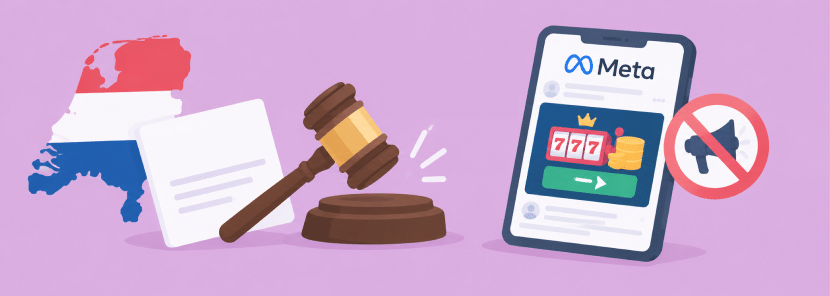

Dutch gambling industry group, the Association of Licensed Dutch Online Gambling Operators (VNLOK), has taken Meta to court over the alleged large-scale distribution of illegal gambling advertisements on Facebook and Instagram.
The organisation filed the lawsuit in the Amsterdam District Court on September 28, 2026, which is essentially the final step in the legal action it announced in June.
Now, VNLOK is looking for a ruling that Meta has failed to meet its obligations under the European Digital Services Act and wants the company to be required to take stronger measures to prevent illegal gambling advertisements that target Dutch consumers.
The lawsuit comes at a time when the Dutch House of Representatives prepares to vote on a motion about the responsibility of online platforms for illegal gambling advertising.
High Proportion of Illegal Ads
According to VNLOK, its research found that more than 90% of the gambling advertisements examined on Facebook came from gambling websites not authorised to promote in the Netherlands.
In its statement, the organisation also noted that Meta removed only 11% of the illegal advertisements identified in May and 15% of those identified in June.
VNLOK argued that removing advertisements after they have been reported is often insufficient since illegal gambling promotions can remain online for only a short period. That’s why the group urges Meta to take a more proactive approach and prevent illegal advertisements from being published in the first place.
“We have repeatedly pointed Meta to the scale of the problem and asked it to work structurally with us on a solution. This has not produced sufficient results. That is why we are now bringing the case before the Dutch courts,” said VNLOK chairman Björn Fuchs.
In his words, the matter has also picked up momentum in the Dutch parliament, where policymakers are weighing in greater responsibility for digital platforms.
Lawmakers Consider Stronger Platform Rules
Bikkers, along with other MPs, submitted a motion which is due to be voted on by the House of Representatives. The proposal would establish that online platforms such as Meta can be considered in violation when illegal gambling advertisements remain visible after repeated reports.
If the motion is passed, the Dutch Gambling Authority (KSA), which oversees Dutch online casinos, would be responsible for imposing a fine or an order subject to a penalty for non-compliance on platforms that fail to take sufficient action.
VNLOK is in favour of the proposal. However, the group said the gambling regulator should not wait for new legislation before taking stronger enforcement action against companies that facilitate access to illegal gambling.
“The KSA already sends many reports to platforms. But when we see how many illegal advertisements continue to appear online despite those reports, it is time to take the next step,” Fuchs explained.
In addition to that, VNLOK stated that the gaming regulator already possesses the legal authority to hold third parties responsible for facilitating illegal gambling to reach Dutch consumers.
Issue Extends Beyond Meta
But according to the gambling group, the issue with illegal ads extends beyond platforms like Meta. It noted that unregulated gaming operators rely on a range of channels to get to Dutch consumers, including advertisements, search results, misleading redirects and Telegram channels.
“Meta is currently the party we are taking legal action against, but the problem is broader. If an illegal operator is removed from one platform, the same operator appears again through another channel,” Fuchs added.
VNLOK argued that all parties involved in the online distribution chain should take responsibility for preventing illegal gambling operators from reaching consumers.
The organisation said its legal action is not directed against social media platforms themselves, but against their alleged facilitation of illegal gambling offerings.
Calling for Stronger Protection of the Regulated Sector
A few years ago, the Netherlands introduced its own regulated market for licensed online casinos, which is subject to robust requirements, including consumer protection, addiction prevention and regulatory supervision.
VNLOK argued that allowing illegal operators to reach Dutch consumers on a large scale through major digital platforms undermines that regulatory framework.
“Politicians can establish clear rules, the KSA can enforce them, and platforms can use their systems to prevent illegal offerings. Those three elements now need to come together.”
VNLOK is now asking the Amsterdam court to determine whether Meta is complying with its obligations under the DSA and, if not, to instruct the company to implement measures aimed at preventing illegal gambling advertisements from reaching Dutch consumers.
KSA Needs International Cooperation
In the meantime, KSA is also amping up its efforts against illegal gambling, and called for stronger international cooperation. In September, KSA chairman Michel Groothuizen said national regulators face limitations when dealing with operators based abroad, particularly as illegal gambling businesses can operate across multiple jurisdictions.
He also highlighted the role of technology and financial companies in helping regulators disrupt unlicensed operators, including by limiting their ability to advertise and process payments.
Groothuizen has also warned that illegal gambling poses significant consumer-protection risks, with some unlicensed operators allegedly targeting players registered with CRUKS, the Netherlands’ self-exclusion system. He argued that greater European cooperation is needed because illegal operators, payment flows, advertising and technological infrastructure increasingly operate across national borders.