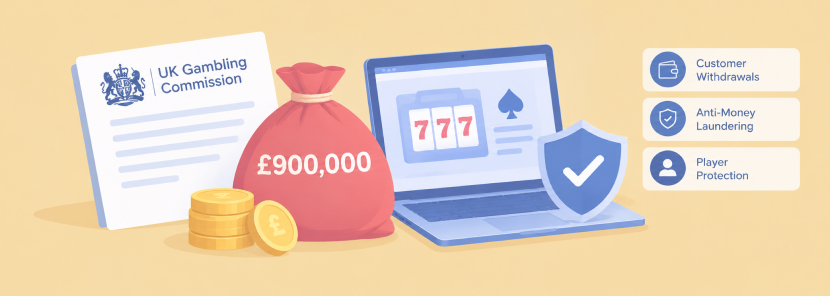

The UK Gambling Commission reports that it reached a £900,000 regulatory settlement with L & L Europe Limited after discovering failures over customer withdrawals, anti-money laundering protocols and player protection.
A UKGC investigation uncovered that the online gambling operator had not consistently met its regulatory obligations between October 2024 and October 2025. Currently, the company operates seven gambling websites across the UK, including All British Casino, CasinoCasino and Hyper Casino.
The settlement comes amidst a regulatory review conducted under the Gambling Act 2005. In addition to the payment tied to a financial penalty, L & L Europe has also agreed to share facts from the case and will help with the Commission’s investigation costs.
Withdrawal Conditions and Delays
UKGC found issues with how the operator performed withdrawals, including a period that restricted customers to one withdrawal request at a time. Customers could not submit another request until the previous one had been authorised.
According to the regulator, which oversees all UKGC-licensed casinos, this condition was unfair under the Consumer Rights Act 2015. Investigators also saw that withdrawal requests were being withheld for reasons unrelated to regulatory or legal requirements.
Another issue was about the company’s policy of manually reviewing every fifth or tenth withdrawal for certain users. Therefore, some players had to provide additional documentation before receiving their funds, even when the information could have been requested earlier.
Still, the operator noted that this process delayed withdrawals and thereafter changed its procedures. But according to the Commission, withdrawals are no longer withheld unless required for regulatory or legal reasons.
Sue Young, UKGC’s Executive Director of Operations, stated:
“A basic expectation is that when you have winnings, you can withdraw those swiftly without hindrance from unfair terms and conditions or the operator failing to carry out checks at an earlier stage. That is essential to consumer trust.”
Anti-Money Laundering Controls Fell Short
The regulator’s investigation also found failures in how L & L Europe reviewed and managed money laundering and terrorist financing risks.
Its risk assessment lacked clarity in several verticals, including how risks were scored, how controls applied specifically to customers in the UK, and how spending disproportionate to a customer’s financial circumstances should be identified and addressed.
Furthermore, the Commission also discovered that the operator relied heavily on financial limits and sampling and did not properly consider individual customer risk profiles.
In one of the cases, a user deposited £4,400 eight hours after registering an account before making a £50 withdrawal. The operator accepted that the source of funds was a gambling account without sufficiently considering that the player’s bank account had been opened only two weeks earlier.
It was determined that the company also failed to verify whether the money held in that account came from employment, business income or savings. The investigation further identified concerns after the customer supplied an incorrect address twice while seeking the release of withheld funds.
After the inquiry, L & L Europe has launched a separate money laundering and terrorist financing risk assessment specifically for Great Britain, taking into account concerns raised by the UKGC.
Safer Gambling and Financial Limit Failures
In addition, the investigation identified shortcomings in the operator’s systems for recognising and responding to potential gambling-related harm.
Safer gambling alerts were available for indicators such as time spent gambling and failed deposits, but they were not active across all the company’s websites. The system also failed to identify certain concerning patterns of behaviour.
For instance, a customer made 84 unsuccessful deposit attempts within seven days because of insufficient funds, but the system did not flag the potential for gambling harm.
The Commission also found that the operator did not have an effective process for assessing if its customer interactions were reducing the risk of harm. In some cases, records of manual reviews contained little detail about the impact of previous interventions, while some required user interactions were delayed or not attempted.
Two cases involving young customers further highlighted the shortcomings. One 21-year-old lost £6,500 within three days of opening an account, while an 18-year-old lost £4,000 in eight minutes. The Commission found that the relevant risk indicators had not been identified.
Additional failures concerned the implementation of financial limits. In one case, a customer returning from self-exclusion had agreed to a net monthly deposit limit of £1,000 but deposited £2,898 and withdrew £1,800 over nine days, exceeding the limit by £98.
The UKGC found that the operator had not effectively implemented the facilities required under its remote technical standards to enable customers to set their own financial limits.
Operator Cooperation and Industry Lessons
The Commission considered the seriousness of the failures and their potential impact on its licensing objectives when determining the settlement. It also noted that similar issues had arisen in previous enforcement cases.
Mitigating factors included L & L Europe’s cooperation with the investigation, its early acceptance of the failings and the action plan it introduced to address them.
Young said the case should serve as a reminder that the regulator would act against unfair gambling practices as well as failures involving anti-money laundering and social responsibility.
The UKGC also called on other licensed operators to review their customer account management procedures, risk controls and staff training. Businesses are expected to ensure their policies are implemented effectively, identify signs of potential harm promptly and assess whether their interventions are working.