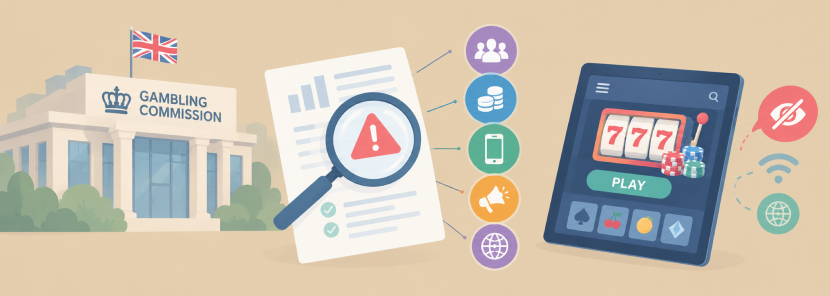

A new report by the UK Gambling Commission identifies attempts to bypass GamStop and avoid sharing personal data as the most common factors for consumers to gamble on illegal online websites.
The report examines why some consumers in Great Britain turn to websites operating without a Gambling Commission licence. It discovered that, while frustration with UK-licensed casinos can contribute, deliberate attempts to avoid access restrictions and identity checks are more closely linked to illegal gambling than searching for better odds or different games.
The Commission stressed that illegal online gambling remains a behaviour associated with a minority of gamblers and that the findings should not be interpreted as representative of the wider gambling population.
GamStop Searches are a Key Gateway
One of the report’s key findings is that the term not on GamStop has evolved beyond its original association with people seeking to circumvent self-exclusion.
According to the UKGC, the phrase has become shorthand for a broader set of features that consumers associate with illegal gambling websites, including fewer identity checks, faster withdrawals, fewer restrictions and credit card or cryptocurrency payments.
The quantitative analysis found that searching for websites not blocked by GamStop was the factor most strongly linked to illegal gambling. Then, playing on websites that require little personal information was the second reason.
Users who admitted to regularly or sometimes playing in either behaviour were approximately 1.5 times as likely to gamble on illegal websites as those who reported engaging rarely or never.
By comparison, browsing for better odds or different games showed a weaker independent relationship with gambling on unregulated sites. Having trouble withdrawing funds was associated with a risk ratio of 1.2, while account restrictions and identity-document requests each had a ratio of 1.1.
Findings imply that illegal gambling engagement is not driven only by players seeking a better experience. Instead, specific efforts to find websites with fewer access limits or lax KYC appear as stronger indicators for engagement.
The report further highlights the role of online communities in channelling users towards illegal platforms. For instance, YouTube has various promos of that, while Reddit acts as a peer-to-peer space where players compare websites, discuss payment experiences and seek reassurance about whether platforms are safe and reliable.
Grouping Consumers in Four Categories
The research builds on previous phases of the Commission’s research by analysing four consumer personas:
- Self-Excluders: avoid GamStop by gambling on illegal websites. They are often influenced by their communities and show an interest in exploring new games, sites and products.
- Skilled Advocates: intentionally gamble on illegal websites and are characterised by distrust of licensed operators and regulatory authorities.
- Social Explorers: do not deliberately choose illegal websites but display behavioural indicators of having used them. They look for promotions, better odds and new games, and trust in recommendations from friends, online forums and influencers.
- Accidental Tourists: unintentionally engage with illegal websites. They care about convenient, seamless experience, fast withdrawals, and can be frustrated by KYC requirements and other restrictions.
Skilled Advocates are likely to seek websites with minimal identity checks and cryptocurrency betting. Overall, 72% of Skilled Advocates reported seeking websites with minimal KYC, compared with 34% of the whole group. Cryptocurrency betting was reported by 62% of Skilled Advocates, against 21% of all surveyed illegal website users.
Also, Skilled Advocates were more likely than the overall group to say they were motivated by making money quickly (81% versus 61%) and recovering losses (78% versus 55%).
Meanwhile, Social Explorers, are more likely to look for promotional offers (86% versus 76% of illegal website users), better odds (81% versus 58%) and improved return-to-player percentages (63% versus 37%).
Finally, for Accidental Tourists, the priority was a smoother experience. The report found that 66% looked for fast withdrawals, compared with 54% of the overall group, while 79% agreed that they did not want to be bothered by operators when gambling, against 52% overall.
Friction in the Licensed Sector Leads to Switching
UKGC founds that identity verification, financial checks, account restrictions and withdrawal delays can contribute to users’ decisions to go for illegal alternatives.
Some participants described KYC requirements and requests for financial documentation as intrusive, specifically when they felt operators were asking for information they had already provided.
For Skilled Advocates, these experiences often support a wider belief that licensed casinos were restricting their personal freedom or acting against their interests. The research found that this group was generally more distrustful of gambling companies, government and regulators.
Social Explorers and Accidental Tourists often view the same conditions more pragmatically, and see them as inconveniences. Their choice to bet on illegal websites was more often associated with convenience, promotions, recommendations and a desire for a seamless user experience.
However, the UKGC warns that leaving the licensed market does not necessarily resolve the problems users are trying to avoid. Identity verification and financial checks can also be seen on illegal platforms, potentially exposing consumers to the same issues in a less protected environment.
The report also underlines concerns about withdrawals. Consumers discussing illegal alternatives online often seek fast access to their money, with crypto casinos usually providing offering quicker payouts. Yet users continued to seek reassurance from online communities about whether individual websites could be trusted.
Targeted Interventions as the Next Goal
The research suggests that a uniform approach to tackling illegal online gambling may be inefficient due to different consumer groups responding to different incentives.
The gambling regulator argues education and awareness campaigns could be more effective for Social Explorers and Accidental Tourists, who may be unaware that a website is not regulated.
For Skilled Advocates, the report suggests enforcement action and disruption of the illegal gambling ecosystem, alongside efforts to address the underlying sources of frustration with the licensed market.
The Commission also intends to use the research to improve its monitoring of illegal gambling website engagement. The Illegal Incidence Index developed through the research programme has been integrated into the Gambling Survey for Great Britain, providing a framework for tracking changes in the composition of illegal website users over time.