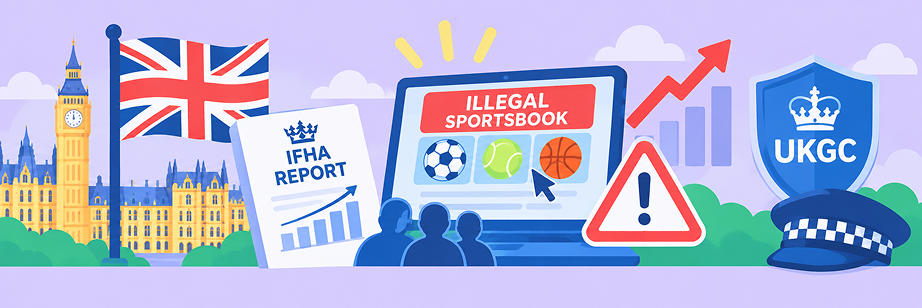

According to a report by the International Federation of Horseracing Authorities, unregulated sports betting sites continue to capture a large portion of UK wagering volume despite increased enforcement efforts by the UK Gambling Commission.
The analysis found that illegal betting websites recorded 19.4 visits for every 100 visits to licensed sports betting sites between January and July 2026. This compares with just one visit per 100 visits to legal websites in late 2021.
The report examined traffic on 301 betting websites with horse racing, including 74 licensed and 227 illegal platforms. It assessed UK visitor activity between August 2021 and July 2026, noting the growing grip of unlicensed operators on the market.
Illegal website traffic eased from its 2025 peak, but the report calculated that full-year 2026 traffic would remain more than ten times higher than in 2022.
Illegal Betting Increased Fourteenfold Between 2022 and 2025
It was discovered that unregulated sportsbook traffic spiked between 2022 and 2025, while betting on regulated platforms declined.
Illegal websites recorded around 1.79 million visits in 2022, compared to 25.13 million in 2025, whilst traffic to licensed casino websites fell from 143.84 million to 94.58 million over the same period. It was a massive fourteenfold increase in illegal website traffic, while it meant a 34% drop in volume for legal sites.
Something similar was seen in the first seven months of 2026, as illegal sites clocked approximately 11 million visits, compared to the 56.87 million for licensed ones. Therefore, the report projects that illegal website traffic would reach approximately 18.9 million visits for the full year. Licensed website traffic was projected to reach 97.5 million.
The report suggested that several factors could explain the growing popularity of illegal platforms. For instance, an increase in affiliate promotions, better search engine and social media visibility, more payment methods and technology that reduces friction for customers.
On the other hand, factors such as tighter checks and account controls in the regulated market may have contributed to declining traffic with licensed brands. However, the analysis could not establish a direct statistical relationship between regulatory changes and consumer trends.
Illegal Operators Are Becoming More Competitive
The report also identified changes in how customers interact with illegal betting websites. Between October 2024 and July 2026, visitors spent longer on illegal platforms and viewed more pages per visit. Engagement with licensed websites declined across several measures.
Average visit duration on illegal websites increased from five minutes and 38 seconds in late 2024 to seven minutes and 25 seconds in the first seven months of 2026. For contrast, average visit duration on licensed platforms fell from 11 minutes and 18 seconds to nine minutes and 57 seconds.
Illegal website visitors also viewed an average of 6.98 pages per visit in January-July 2026, up from 5.19 in late 2024. Licensed website visitors viewed 7.66 pages per visit, down from 7.75. The bounce rate, which measures the percentage of visits ending after a single page, also showed a tightening gap.
Illegal websites recorded a bounce rate of 48.9% in the first seven months of 2026, compared with 30.6% for licensed platforms. Licensed operators may have maintained stronger engagement figures across all three measures, but the report said the differences were narrowing.
Regulator Expands Enforcement Activity
The report’s findings come at a time of improved efforts by the UK Gambling Commission to deal with the growing illegal gambling sector.
Since April 2024, the regulator has issued more than 3,100 cease-and-desist and suspension notices. It has also referred more than 447,000 URLs to Google and Bing, with almost 288,000 URLs subsequently removed.
Its enforcement strategy increasingly targets businesses supporting illegal operators, including affiliates, advertisers, search engines, social media platforms, payment providers, domain registrars and hosting companies.
Additionally, the government established an Illegal Gambling Taskforce in May 2026, which is currently headed by the Department for Culture, Media and Sport.
The taskforce brings together regulators, law enforcement agencies, government departments, technology platforms and payment providers. Its priorities include restricting payments to illegal operators, tackling online gambling advertising and improving cooperation between enforcement bodies.
Separately, the Government consulted in July 2026 on legislation that would prohibit unlicensed operators from entering advertising and sponsorship agreements in Great Britain. The proposed restrictions would cover sports clubs, competitions, venues and events.
However, the IFHA report concluded that enforcement activity had not yet translated into a sustained reduction in illegal betting traffic.
Regulatory Changes Could Increase Pressure on Licensed Operators
The report also highlighted the growing regulatory and financial requirements for licensed operators. Since February 2025, companies must conduct light-touch financial vulnerability checks when users’ net deposits exceed £150 within a rolling 30-day period.
The statutory gambling levy from April 2025 replaced voluntary industry contributions towards gambling research, prevention and treatment. Its first collection raised nearly £120 million in the second half of 2025.
Licensed operators have also faced compulsory online slots stake limits, additional financial controls and new transparency requirements. From September 30, 2026, online operators must offer customers a gross deposit limit and give it at least equal prominence to other financial limits.
Meanwhile, starting from April 1, 2027, the new 25% General Betting Duty rate will apply to most remote betting. Currently, online bets on UK horse racing are taxed at a 15% rate, which reflects operators’ separate contributions to the Horserace Betting Levy.
The report warned that these changes could further widen the gap between licensed and illegal operators, which are not subject to equivalent regulatory obligations or financial contributions.
It also raised concerns about potential consequences for British horse racing. Illegal operators accept bets on British racing without contributing to the Horserace Betting Levy or participating in the sharing of suspicious betting information.
The report suggested that the higher duty on most remote betting could indirectly affect legal racing turnover if multi-sport bettors move more of their activity to offshore platforms.
It concluded that the effectiveness of the UK’s regulatory approach should be measured not only by enforcement actions but also by lasting reductions in illegal website traffic, access to payments and online visibility.