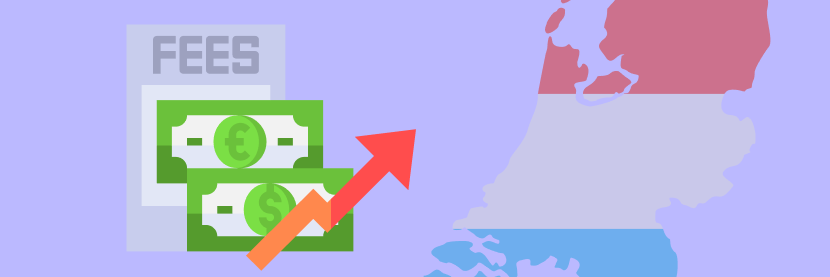

This week, the Dutch government announced a significant increase in the fees for gambling licence applications. The changes are scheduled come into effect on April 1, 2026, and will affect both land-based and online casino operators.
With these modifications, the government wants to ensure that the Dutch Gambling Authority has more than enough funds to handle the increasing wage and operating costs. The fee hikes were announced in a regulation published in the Staatscourant and signed by the State Secretary for Justice and Security on January, 13 2026.
The new regulation will amend the existing directions that surround the costs associated with applying for, modifying or renewing gambling licences under the Dutch Gambling Act.
Broad Impact on the Gambling Sector
The revised fee structure applies to lotteries, casino games, sports betting, and online casinos. It stretches to applications submitted under multiple articles of the Gambling Act, such as those tied to lotteries, totalisators, casino operations and remote gambling.
Under the new tax rates:
- Fees for small incidental lotteries increase from €500 to €600
- Fees for larger incidental lotteries rise from €24,000 to €30,600
- Applications for non-incidental gambling licences increase from €28,000 to €35,800
- The fee for an online gambling licence rises sharply from €48,000 to €61,300
In addition to new licence submissions, higher fees will also apply to requests to amend existing permits. Applications for the expansion or replacement of the permitted gambling offer, or those requiring renewed integrity and reliability assessments, will be increased from €8,000 to €10,200.
Cost Recovery is Key
According to the explanatory memorandum attached to the new regulation, the main objective of the fee increases is to ensure that the gambling regulator can recover the full costs associated with processing licence applications.
“The fees that must be paid to the Gambling Authority for the handling of applications relating to gambling licences must be cost-covering,” the document states.
The government emphasises that the revised tariffs do not represent a policy shift towards higher taxation and describes them as an administrative adjustment which reflects the current economic conditions.
Indexation Linked to the Authority’s budget
The regulation details how the new fees were calculated by indexing tariffs first set in 2021. The updated figures are based on the Gambling Authority’s 2026 budget, which divides costs between personnel and material expenses.
According to the budget breakdown, 83.5% of the authority’s costs are attributed to personnel, while 16.5% relate to material and operational expenses.
“The indexation consists of a division between personnel and material components, derived from the 2026 budget of the Gambling Authority,” reads the regulation.
This methodology has been applied consistently across the different licence categories to ensure proportional increases across the sector.
Reduced Tax Maintained for Community Lotteries
Despite the general rise in fees, the government has chosen to keep a reduced tax for certain small-scale incidental lotteries, often organised by sports clubs, charities and local associations.
“In particular, it is noted that a reduced tariff has been chosen because of the social importance of the so-called canteen lottery,” the document explains.
However, the regulation clarifies that even these reduced fees have been increased in line with the broader revision. The document states that the increase is applied “in the same manner as the other hikes.”
Part of Fixed Regulatory Timetable
According to the Dutch government, the recently announced regulation will come into effect on April 1, 2026, which is in accordance with the local fixed changeover moments for ministerial regulations. The publication date ensures a minimum notice period of two months for affected parties.
“The regulation will enter into force on April 1, 2026,” the document confirms.
Implications for Operators
The higher fees are expected to increase upfront costs for new market entrants and operators seeking to expand or amend their licences, particularly in the online gambling sector.
It will take some time for companies that already hold a license to experience the new charges unless they submit applications. However, industry stakeholders may see the changes as another cost pressure in an already tightly regulated market.
Still, the Dutch government insists that the revised fees are necessary to ensure effective supervision and enforcement by the Dutch Gambling Authority, without shifting the financial burden on consumers and taxpayers.
Seeking Help Remains an Issue
Just recently, the Authority highlighted another key issue. It discussed how speaking about one’s gambling problems remains a challenge in the Netherlands.
New research commissioned by the gambling watchdog shows that there is still stigma, misinformation, and other social barriers that keep gambling addiction largely out of public conversation, despite gambling being a widespread activity.
More than half of respondents, or approximately 53%, say they do not know where to go for help if they or someone close to them were to develop a gambling addiction. This lack of clarity significantly raises the threshold for seeking assistance.