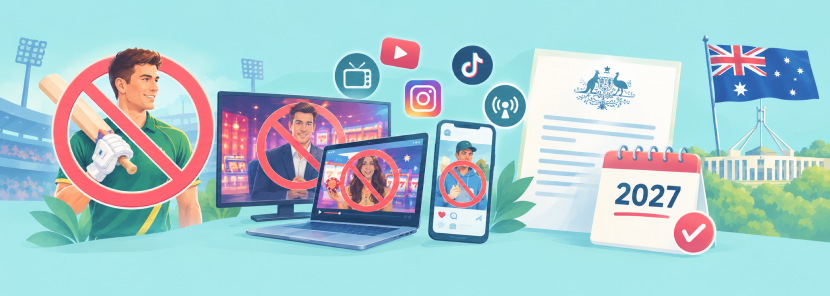

Australia has published initial guidance on new restrictions that ban notable individuals from appearing in gambling advertising. These new rules are on track to go into effect on 1 January 2027.
On October 19, 2026, the Australian Communications and Media Authority released the guidance, which aims to help Australian casinos prepare for the upcoming requirements under the Interactive Gambling Amendment (Gambling Reform) Act 2026.
The legislation was passed into law on August 26, 2026, and introduces restrictions on betting advertising across broadcast television, radio and online platforms. It also implements separate prohibitions on gambling advertising on sporting uniforms and at venues during live sporting events.
Under the new rules, betting advertisements must not feature notable individuals, whether they appear in broadcast content or online. Licensed operators will also be restricted from signing contracts, arrangements or understandings involving popular personalities to promote wagering advertising content across Australia.
These restrictions will apply across platforms including television, radio, news websites, online games and social media.
Broad Definition of Notable Persons
Furthermore, the legislation offers a definition of the term notable person as a current or former professional sports player or athlete, celebrity, social media influencer or prominent individual. The description also applies to people belonging to any additional class determined by the Minister for Communications.
According to the ACMA, the definition was deliberately left broad and is intended to capture individuals whose public recognition could encourage gambling through their association with a certain gambling brand.
The regulator also elaborated that the restrictions are not limited to people who appeal to children. Notable individuals may also influence people vulnerable to gambling harm and younger audiences, including younger men.
ACMA’s guidance explains that the regulator will review potential breaches of the rules on a case-by-case basis, considering factors such as an individual's public profile, media exposure, professional achievements and ability to influence consumer decisions.
A person’s recognition within a particular community or demographic may also be relevant, meaning that national fame is not necessary for someone to fall within the definition.
The regulator also clarified that there is no specific follower threshold for social media influencers. Individuals with relatively small audiences may still be considered notable if they have influence or recognition within a particular community.
Notability Can Change Over Time
In addition, the ACMA warned that an individual’s status may change during an advertising campaign, potentially requiring operators to withdraw existing promotional material.
An instance of that would be when an actor who initially has little public recognition could become notable after securing a leading role in a successful television series and gaining a substantial social media following. In such cases, the operator may need to stop broadcasting or publishing ads featuring that person once they become notable.
The guidance states that operators must take all reasonably available steps to cease or withdraw affected advertising. The ACMA may consider the length, reach, scale and likely impact of an advertisement when assessing reasonable timeframes for its withdrawal.
Also, the regulator warned regulated operators about their relationships with third-party advertising agencies. Businesses that currently outsource the development of promotional material must ensure that the final advertisements comply with the new restrictions.
The obligations rest with licensed wagering service providers rather than the individuals featured in advertisements. Operators may therefore face enforcement action if they authorise or cause prohibited advertising to be broadcast or made available online.
Racing Advertising Exemption
The legislation provides a limited exception for advertising involving notable people when specific racing-related conditions are met.
The exception applies when wagering advertising relates solely or principally to racing and is broadcast on a dedicated racing program or channel, or provided through a dedicated racing online content service. However, both conditions must be met for the exemption to be valid.
The ACMA explained that the exception recognises the established relationship between wagering and racing, as audiences consuming racing content may reasonably expect to encounter gambling advertising.
However, programs that cover racing alongside other sports may not qualify. The guidance gives the example of a program featuring horse racing as well as National Rugby League and Australian Football League coverage, which would be unlikely to meet the requirement that the content relate principally to racing.
The regulator said the initial guidance should help operators understand their obligations ahead of the rules taking effect. It may issue further formal guidance on the operation of the notable persons provision at a later date.
Palmerbet Case Highlights Compliance Obligations
The ACMA’s guidance comes amid wider regulatory action against wagering operators. In a separate investigation, the regulator found that Palmerbookmaking Pty Ltd, which operates Palmerbet, breached the country’s self-exclusion requirements.
The operator allowed a customer registered with BetStop, Australia’s National Self-Exclusion Register, to place 312 bets across 18 days. The ACMA also identified 535 breaches relating to the failure to close the customer’s account promptly. It did not establish any breaches of the relevant marketing provisions.
Palmerbet has agreed to an 18-month court-enforceable undertaking, including an independent review of its compliance systems and the implementation of the review’s recommendations. The operator has also repaid deposits made by the customer after their BetStop registration and before the account was closed.