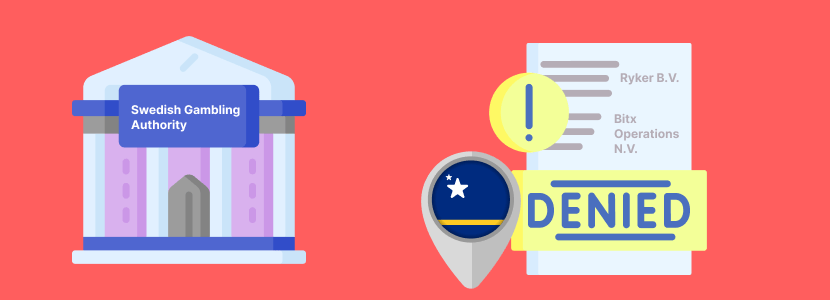

The Swedish Gambling Authority, also known as Spelinspektionen, has recently banned two Curaçao-based online gambling operators. The brands in question are Bitx Operations N.V. and Ryker B.V..
Sweden’s gambling regulator claims they were conducting gambling business in the country without the required licenses. The move is another example of the country’s strict gambling laws and its commitment to protecting users from unregulated iGaming platforms.
Cases Background
In its statement, the Swedish casino watchdog explained that it had discovered that both companies tried to actively target and attract Swedish consumers. However, neither of them had proper authorisation under the country’s Swedish Gambling Act.
The Authority investigated the matter and found that the websites playbet.io, run by Bitx Operations, and jackbit.com, operated by Ryker B.V., were specifically designed and tailored with an evident focus on the Swedish iGaming sector.
Findings from the Investigation
SGA reported that playbet.io offered content in Swedish, as well as preselected Swedish currency and a Swedish county code when opened from a Swedish IP address. Additionally, the website’s terms and conditions were updated for local players. It was also found that the operator’s affiliate partners ran marketing campaigns in the country.
In a similar fashion, jackbit.com also had Swedish text, a preselected Swedish country code, and marketing in Swedish. In both instances, the websites allowed local consumers to register an account, further proving that the platforms were accessible and tried to attract Swedish users.
Licensing Status
Currently, Bitx Operations N.V. is licensed and regulated under the Curaçao gambling authority with a license number of 8048/JAZ. Meanwhile, Ryker B.V. operates under a Curaçao Gaming Control Board license OGL/2024/1800/1049.
However, having an offshore license doesn’t permit operators to conduct business in the Swedish gambling market. Also, Swedish rules state that operators who run content targeted at local consumers must have an active license from the Swedish Gambling Authority. However, both operators lack such a license.
Statement from the Authority
“The Gambling Act is designed to ensure that gambling in Sweden takes place only with responsible, reliable, and controllable operators,” “Operators without a Swedish license must be excluded from the market to protect consumers and maintain safe gambling practices,” the Authority noted in its official statement.
Legal Framework Overview
The Swedish Gambling Act sets out a strict licensing framework. Therefore, it makes it illegal for operators to offer gambling products across the country without the required license. This also applies to casino brands based outside of the country if their services try to target and appeal to Swedish audiences.
To investigate the Authority checks for indicators like Swedish-language content, the use of its official currency, preselected country codes, and marketing aimed at Swedish players. So far, this has helped it determine if a website is operating in its remote gambling sector without the mandatory license.
Enforcement and Compliance
Nevertheless, Spelinspektionen has allowed the operators to respond to the investigation. However, neither of the two has written to the regulator so far. Still, their bans are with immediate effect, and if they don’t comply, they could face further legal action and financial penalties.
The Authority’s rulings were inked by Unit Manager Robert Larsson, after case presentations from Case Officer Carina Fogelberg. The gambling regulator also vows that it will continue to oversee the online casino market and take action against operators in an effort to protect its player base.
Potential Impact on the Sector
SGA’s latest bans for offshore operators further underline the country’s attempts to provide a safe and governed gambling environment for consumers. The framework for the local iGaming sector is designed around transparency, user protection, and, last but not least, responsible gambling.
In the meantime, by constraining unlicensed operators, the Authority tries to push all gambling activities to regulated platforms. Thus, it limits the risks of possible fraud, money laundering and unsafe gambling practices for consumers.
The recent bans can also be a reminder of what’s to come for unregulated operators who try to do business with no proper authorisation in the Swedish iGaming sector. SGA has reiterated on numerous instances that no targeting of Swedish players will be tolerated from offshore operators. And it can lead to consequences for third-party platforms.
Market Channelisation Drops to 85%
Last week, SGA posted an update on the channelisation rate of the regulated iGaming market for 2024. According to the regulator, last year, the total channellisation dropped to 85%. For comparison, it was slightly higher, 86%, in 2023.
The Authority’s channelisation rate keeps track of how much of the gambling happens on online casinos licensed to operate in the country. Hence, providing an overview of the iGaming sector and where players prefer to wager.
To calculate the chanelisation, the iGaming watchdog used a new formula, using different indicators to better evaluate the sector. Those indicators were a survey of the player bases and measurement of internet traffic. However, the regulator will likely try to improve channelisation to ensure more players engage with safer and regulated iGaming sites.