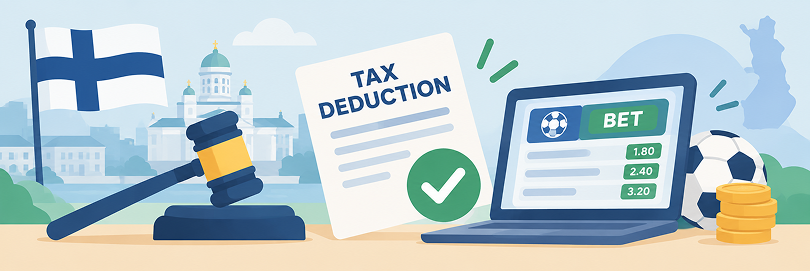
















































Finland’s Supreme Administrative Court has issued a significant ruling on the taxation of online gambling. The decision would allow players in certain circumstances to deduct stakes from lost games when calculating taxable winnings from gambling outside the European Economic Area.
The ruling is seen as a major shift from the Finnish Tax Administration’s previous strict game-by-game approach to taxation. Under the new verdict, gambling activity can instead be assessed as a broader gambling session, which could allow stakes from losing games to be taken into account.
“The most important aspect of the ruling is that the Supreme Administrative Court did not accept the Tax Administration’s view that every game should be treated as a completely separate event,” said Miika Härkönen, a tax lawyer at the Finnish Taxpayers’ Association.
According to court records, the ruling was reached by a narrow 3-2 majority. Härkönen said the minority would have gone further in expanding the right to deductions.
Ruling Changes Treatment of Gambling Losses
The case concerned gambling conducted outside the EEA, including Curaçao-licensed casinos and others operating within Caribbean jurisdictions. At the same time, in Finland, winnings from gambling organised within the EEA are generally tax-free.
The dispute discusses how wagers and losses should be treated when winnings are subject to tax.
Under the Tax Administration’s previous variation, stakes could not be deducted from winnings in slots. The Central Tax Board later relieved that position by allowing stakes associated with winning games to be deducted.
Now, the Supreme Administrative Court has extended the principle further and says that stakes from lost games may also be deductible when they form part of the same gambling session.
Therefore, the definition of a gambling session could become particularly important when the ruling is applied in practice.
“It is not yet entirely clear where the boundaries of a gambling session lie. What is clear, however, is that the assessment extends beyond an individual game. This makes it possible to deduct the stakes from significantly more lost games than before,” Härkönen explained.
He suggested that gambling with a clear temporal and functional connection could count as one session, even when the player takes breaks.
An example of that would be a user playing throughout a Saturday with breaks for meals or other activities, which could still be considered a single gambling session. Meanwhile, repeating the same activity the following Saturday would constitute a separate session.
Existing Tax Assessments Could Be Reviewed
The ruling could also have implications for gamblers who have already received tax assessments based on the previous rendition.
Players whose taxable winnings were calculated on a game-by-game basis, without deductions for losing stakes, may now be able to explore whether their tax liability would change under the gambling-session approach.
Overall, taxpayers can seek reassessment retrospectively for up to three years. Therefore, in 2026, some players may still be able to challenge their 2023 tax assessments. Meanwhile, the Finnish Tax Administration is also expected to update its guidance to reflect the Supreme Administrative Court’s decision.
The ruling may be particularly relevant because gambling at online casinos outside the EEA is widespread, while some players may not have been fully aware of the tax implications of their winnings.
How the Issue Reached the Supreme Administrative Court
The matter came to the attention of the Supreme Administrative Court from an inquiry received by the Finnish Taxpayers’ Association. It was about a young person who had already suffered financial losses through gambling but also faced the possibility of a substantial tax bill.
Under the previous interpretation, individual winning games could generate taxable income even when the player’s overall gambling activity was loss-making, because stakes from losing games could not necessarily be deducted.
The new ruling addresses part of this problem by allowing a broader assessment of connected gambling activity.
It also supports the general principle that taxation should, where applicable, be based on net income after deductible expenses associated with generating that income have been taken into account.
Betting Case Could Bring Clarity
However, it should be clarified that the latest decision does not settle all questions surrounding gambling taxation in Finland.
The Supreme Administrative Court is also expected to give its ruling on the taxation of professional betting. That case will again involve the question of whether losing bets can be deducted, while also examining the nature of the betting activity itself.
A central issue will be whether systematic, profitable betting conducted over several years and involving large stakes should be considered a business activity, another form of income-generating activity or merely a hobby for tax purposes.
For professional bettors, the volume of bets is particularly important. A positive expected value does not mean every individual wager will be profitable; rather, a sufficiently large number of bets can produce an overall profit.
As a result, losing bets are an inherent part of pursuing profits, making their tax treatment a key issue in the forthcoming case.