













































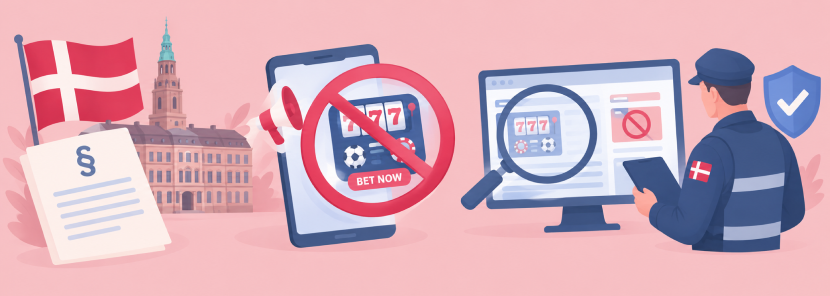

Denmark has introduced a new bill proposing stricter gambling advertising rules, stronger responsible-gambling requirements, and expanded authority to tackle unregulated gambling.
Officially referred to as Bill L 37, it was presented to the Danish Parliament on October 7, 2026, by the Tax and Growth Minister Jakob Engel-Schmidt. The proposal is a revised reintroduction of legislation previously presented in the 2025-26 parliamentary session.
The bill implements measures agreed under Denmark’s October 2025 “Spilpakke 1” agreement, which would attempt to tackle gambling addiction and strengthen protections for children and young people. The government said the tabled changes would address concerns around gambling advertising, prevention and enforcement.
Gambling Ads Could Face Wider Restrictions
A key topic of the proposal is the tightening of advertising rules for Danish casinos.
The bill would prohibit gambling advertising on public transport and in public areas within 200 metres of schools and youth education institutions where most students are under 18. The distance would be measured from the institution’s outer property boundary.
Additionally, advertising would also be banned from live sports broadcasts. Under the proposed rules, gambling ads could not be shown from 10 minutes before a live sporting event begins until 10 minutes after it ends.
The restriction would cover both traditional television and streaming services. It would also apply to live odds shown during the broadcast. Physical advertising at sporting venues, such as banners and shirt sponsorships, would generally remain outside the restriction, but live odds displayed at the venue would be hidden.
The bill would also compress the content of gambling advertising. Ads could not use people under 25, portray gambling as a priority or lifestyle, suggest that gambling provides financial solutions or social acceptance, or portray gamblers as smarter, more successful or more popular than others.
Social media advertising would also have to be prevented from targeting people under 18.
Influencers and Affiliates Face Greater Responsibility
The bill would also extend penalties for gambling marketing beyond licensed Danish casinos.
The legislation states that influencers and affiliates currently promote gambling and can be compensated based on player activity. It proposes allowing physical and legal persons involved in gambling marketing to be held responsible for breaches of the advertising rules.
Another proposed measure would prohibit commission arrangements based on players’ turnover, winnings or losses. According to the government, the goal was to remove financial incentives for affiliates and other partners to encourage people to gamble more than they otherwise would.
The proposal would also prohibit the transmission of information over communication networks for illegal marketing activities.
Operators Would Face New Responsible-Gambling Duties
In addition, the bill would implement a statutory duty for gambling licensees to monitor player behaviour and act when signs of potential problematic gambling or gambling addiction occur.
Operators would also have to constantly evaluate the effectiveness of their responsible-gambling measures and maintain written internal rules and procedures to prevent problematic gambling. Relevant employees, retailers and employees of retailers would need appropriate training and would have to follow those procedures.
The proposed duty would apply to gambling sectors, rather than only to areas already covered by existing requirements. For instance, land-based bingo operators would also become subject to the obligation.
The government mentioned data that suggests that almost 500,000 Danish adults had experienced some degree of gambling problem in 2021, while noting the broader effects gambling addiction can have on employment, education, relationships and finances.
Stronger Powers Against the Unregulated Market
The proposal would also expand the Danish Gambling Authority’s enforcement powers.
Among other measures, the authority would gain the power to inspect premises suspected of being used to offer or arrange pyramid schemes without a court order. It would also be able to request information and documents relevant to its investigations.
The bill would strengthen the framework for penalties by making clear that a company’s turnover can be considered when determining fines. The economic benefit obtained or intended through an offence would also be given particular weight.
For offences that are not expected to warrant a penalty beyond a fine, the Gambling Authority would be given the power to issue administrative penalty notices. The authority would therefore take over a role currently assigned to the minister or an authorised representative.
The proposed law would also make it an offence to intentionally or through gross negligence offer, arrange, supply or sell gambling in Denmark without the required permission. Such violations could carry a fine or imprisonment of up to six months, rising to one year under aggravating circumstances. Marketing illegal gambling would also be punishable by a fine.
Changes Would Take Effect in Stages
The bill comes with a proposed phased implementation and would generally enter into force on January 1, 2027. However, the main gambling advertising and responsible-gambling provisions would apply from July 1, 2027, while a wider group of amendments would take effect on October 1, 2027.
The proposal also includes several measures to modernise Denmark’s land-based gambling framework and expand the gambling definition. Among other changes, dice games and roulette-style games would be brought into the online casino framework.
The bill’s financial assessment predicts that extending the online casino definition is expected to generate around DKK 10 million in additional annual revenue from 2027. By contrast, the live-sports advertising ban is estimated to reduce state revenue by around DKK 25 million annually from 2027.
Nevertheless, it should be noted that the proposed changes now form part of the parliamentary process and could still be amended before becoming law.